Our Kindergarten classrooms are structured learning communities. Teachers will create opportunities for students to investigate, represent and reflect on what they are learning. Learning experiences and play activities will have concrete end goals and are designed to instill a sense of competency through the creation of finished products. The teachers’ role in this learning community is to assess what children already know about a given subject or skill and to provide active learning activities that will help them to construct new understandings based on that knowledge. Teachers provide feedback and appropriate choices for children throughout the learning process, trying to guide children to make sense of new information, not just to memorize it. These learning activities will target the development of skills in the following areas: Literacy /Writing, Mathematical Thinking, Social Studies, Scientific Thinking and Technology. The Kindergarten program is executed via thematic units based on the arts. Units will communicate content information through various art mediums such as music, visual arts and dramatic play.
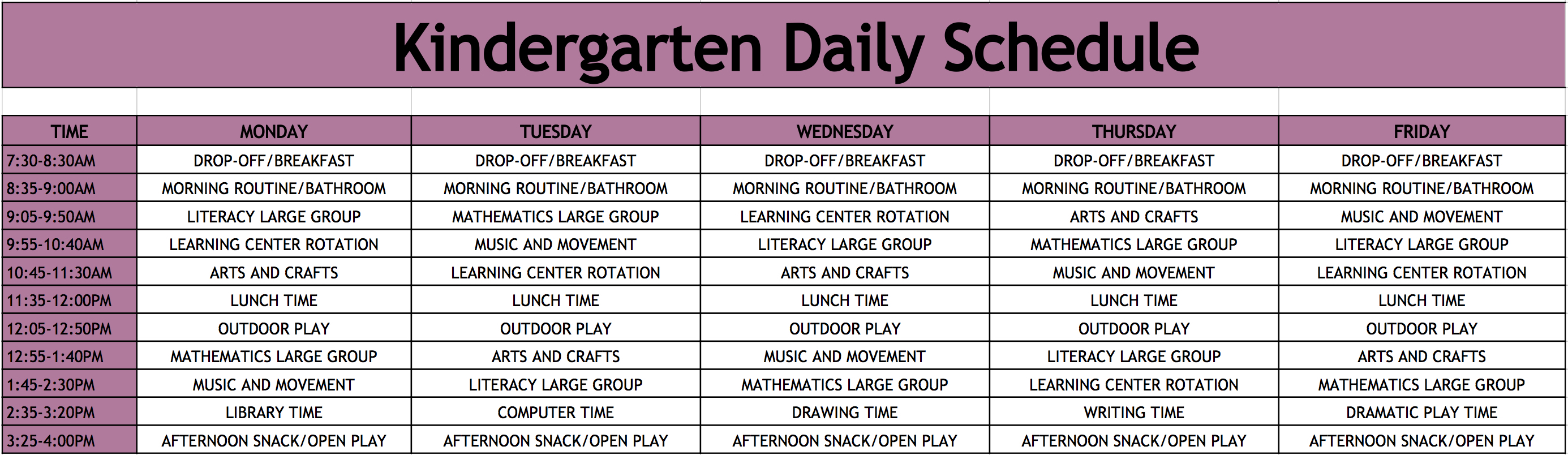
As students develop the cognitive skills necessary for grade school, they will become less dependent on adults. At the Kindergarten level, teachers will create a structured environment in which students share responsibility for keeping the classroom neat and orderly, know how to get and use materials properly, and function with increasing levels of independence. Structure comes from a well-organized classroom environment, a daily schedule, routines that are predictable and clear expectations about behavior in an elementary classroom.